
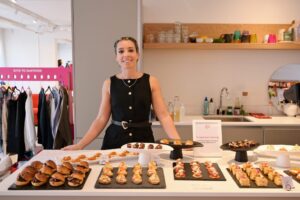
 Elena Menor followed her passion for food and cooking to launch Perspective Catering after COVID. She shares how to cultivate resilience when moving to a new country and facing new challenges, how to start a business from scratch, top tips to host impressive networking drinks on a budget… plus one ingredient that will elevate your dishes to a sophisticated level.
What led you to make the leap from banking to gastronomy?
The existential emptiness that I felt during COVID. I decided that I didn’t want the corporate work-life anymore. I also wanted to feel useful and do work that feels purposeful and makes me happy. Gastronomy had always been my passion, and so I decided to do something that would allow me to create experiences and connect with people.
How did your family’s encouragement support this transition?
My family’s input has always been fundamental in life decisions. My mum said, “Leave this corporate world because you are not happy”. Knowing that I had their trust (even though I was far away) gave me the emotional security I needed to take the step towards a different career.
You changed your career, you lived in Austria and then moved to the Netherlands. How did you maintain resilience during these transitions?
Moving was a challenge, but also one of the experiences that has transformed me the most. In the beginning, it’s all uncertain, you’re out of your comfort zone, starting from scratch, but I learned to see it as an opportunity to grow and rediscover myself.
For me, resilience came from connecting with myself and with what I really wanted to build, focusing on what made me happy – which is seeing people enjoy my food. Each change forced me to adapt, to observe, to learn from new cultures and to develop an open mind. In the beginning, I felt alone here. I had no friends; my family was far away. But I knew I had to follow my heart.
In time, I understood that resilience is not about avoiding discomfort or loneliness, but about moving with it, because it is part of growth. That process has been key, not only on a personal level, but also professionally – for example, the way I create experiences with Perspective Catering: with sensitivity, intentionality and an international view. I believe every place you experience teaches you new and different perspectives.
Resilience is not about avoiding discomfort or loneliness, but about moving with it, because it is part of growth.
Many people in our community are dealing with uncertainty and new situations. What strategies helped you get through the unease of uncertainty?
What helped me was sport. I went to Austria to snowboard. I met new people, and it felt amazing to make new connections and listen to their stories, and to receive encouragement for the changes I was making. It made me feel less alone and more supported in the process of changing my life. Connecting with others really helped.
The catering and cheffing world is very male-dominated. How did you experience that environment?
That’s true. In fact, I am the only woman in the kitchens where I work. It’s funny because when we think of home cooking, we think of women – grandma’s special recipe, for example. But when we think of restaurants, we think of men. I think that’s because it’s a high-pressure environment. It’s not that women can’t manage the pressure – I think women are super powerful and can do anything they set their mind to – but it is a difficult environment to work in, being alone in a kitchen full of strong male personalities. What helped me to get through this was that I wanted to do something for myself. In restaurants you have to cook other people’s recipes, and I’m much happier when I’m cooking my own food and seeing people enjoying what I’ve created.
What inspired the global flavours of your menu?
The inspiration comes from living in different countries and being curious about other cultures. I like to reinterpret traditional flavors from a personal perspective, creating dishes that reflect my journey. I’ve cooked in France, Portugal, Italy, Bali, Thailand and of course, my home country, Spain. I sometimes feel like I’m describing the history of my life through food.
How did you choose the name Perspective Catering?
The name comes directly from my personal story. I was facing big changes, and I understood that what I needed was not to start again, but to learn to look at my life from another perspective: to reconnect with what I was really passionate about and dare to follow that path.
“Perspective” reflects just that: my understanding of gastronomy, where each event tells a unique story, and my own journey. Each experience, each country and each decision have taught me to reinterpret, adapt and create something with intention. In the end, my business is an extension of that way of seeing the world.
Each experience, each country and each decision have taught me to reinterpret, adapt and create something with intention. In the end, my business is an extension of how I see the world.
You focus on aesthetics, table décor and an elegant presentation – why is that important?
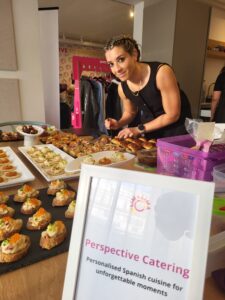 The gastronomic experience begins long before the first bite. Food presentation is not only about aesthetics, but also about emotion. The first impression arouses curiosity and expectation. I like to think of a table as a visual narrative: a way of telling a story without words, where every detail has an intention.
Taking care of aesthetics is also a form of respect for the customer and the food itself. It is a way of elevating the everyday, turning it into an experience that is not only savoured, but also felt and remembered.
You’re committed to sustainability and honest cuisine – what inspired that focus, and why does it matter to you?
I believe in responsible cooking, home-made with quality ingredients, and in minimizing waste. That’s not only an ethical decision, but also a way to respect the real flavour of food and where the food comes from. In the restaurants I worked at, all parts of the ingredients were used – for example, making a broth or salt using onion peels.
Tell us a little about how you launched your business from scratch – starting small, managing costs, and building a portfolio?
I started by offering small events, controlling costs and reinvesting everything each time. I built a network of clients mainly through referrals, a Female Ventures event, and doing the job well. People appreciate a job well done, and if they like your work, they will refer you. My business degree was very helpful to keep track of costs, see where I’m earning and what needs to be improved.
In your business, how do you balance intensive personalization and growth?
That is definitely one of the biggest challenges. Personalization is the foundation of everything I do, so it is important that I don’t lose that essence even when my business grows.
I have learned to find balance between creativity and structure. On the one hand, each event is unique, adapted to the client, the context and the story we want to tell. At the same time, I have been optimizing internal processes: planning, suppliers, and menu templates that can be adapted to each proposal.
I prefer to grow organically, maintaining quality and detail, rather than scaling quickly and diluting the experience. In the end, I found balance by building a system that allows me to be efficient while remaining creative and faithful to what defines my brand.
I found balance by building a system that allows me to be efficient while remaining creative and faithful to what defines my brand.
It helps that I’m very structured. That’s something that I developed growing up. I used to help my parents in their shoe-making company while I was studying. I learned to structure and optimize my time.
What made you choose Instagram to grow and define your business’s brand instead of a website?
It was the simplest and fastest way to grow, especially while I was starting out. It is a visual platform which allows me to showcase my work. It also facilitates direct connection with customers and brand-building. I find social networking online quite time-consuming, and face-to-face networking challenging. I’m a bit insecure about speaking another language. But the people I’ve met at Female Ventures have really encouraged me and helped me to feel that I am not alone.
Could you share three tips for entrepreneurs on how to host impressive network drinks on a budget?
- Less is more: select a few dishes but execute them well.
- Play with presentation: You can really elevate simple foods with good aesthetics.
- Focus on drinks: a personalized signature cocktail makes a big difference.
For example, the inspiration for the cocktails I served at a Female Ventures event in collaboration with MyLimaLima in March 2026 came from the color of their logo. I also thought about the audience: women who take care of their well-being, their future, and their connections. I decided to make homemade syrups with real ingredients – a balance between the natural, the elegant, and the carefully designed.
What is one ingredient you believe is underrated in home cooking, and/or one ingredient that can elevate dishes to a sophisticated level?
Without a doubt: good quality extra virgin olive oil. For me, it is more than an ingredient; it is an identity. A good oil, used raw, can transform a dish by providing depth, texture and character. It is that final touch that unites all the other ingredients with elegance.
Connect with Elena on Instagram: